

The Hidden Challenge of Supplier Documentation in the Food Industry
Share this article:
Why Intelligent Supplier Information Management Is Becoming a Competitive Advantage
Food manufacturers invest tremendous resources into sourcing quality ingredients, maintaining food safety, and meeting ever-changing regulatory requirements. Yet one critical operational challenge often remains hidden in plain sight: managing the vast amount of documentation that accompanies every supplier relationship. While these records may seem administrative, they are essential to demonstrating compliance, ensuring product quality, and maintaining supplier accountability.
Supplier documentation extends far beyond purchase orders and invoices. It includes Certificates of Analysis (COAs), supplier certifications, ingredient specifications, allergen declarations, insurance certificates, Bills of Lading, quality inspections, regulatory documentation, laboratory reports, and countless other records that support food safety and regulatory compliance.
Collectively, these documents provide the evidence needed to verify that suppliers continue to meet your organization’s standards.
As supplier networks grow and regulations become more demanding, these documents quickly accumulate across email inboxes, supplier portals, shared network drives, ERP systems, cloud storage, and paper files. Finding the right information at the right time can become increasingly difficult—especially during an audit, regulatory inspection, or product recall—when every minute counts.
What appears to be a simple document management issue often becomes a significant operational challenge affecting compliance, productivity, audit readiness, and business continuity. Organizations that continue relying on manual processes frequently spend valuable time searching for information instead of acting on it.
The organizations that successfully address this challenge are moving beyond document storage toward intelligent supplier information management. By combining intelligent capture, AI-powered document processing, enterprise content management, and workflow automation, they are transforming supplier documentation into trusted business information that supports faster decisions, stronger compliance, and greater operational efficiency.
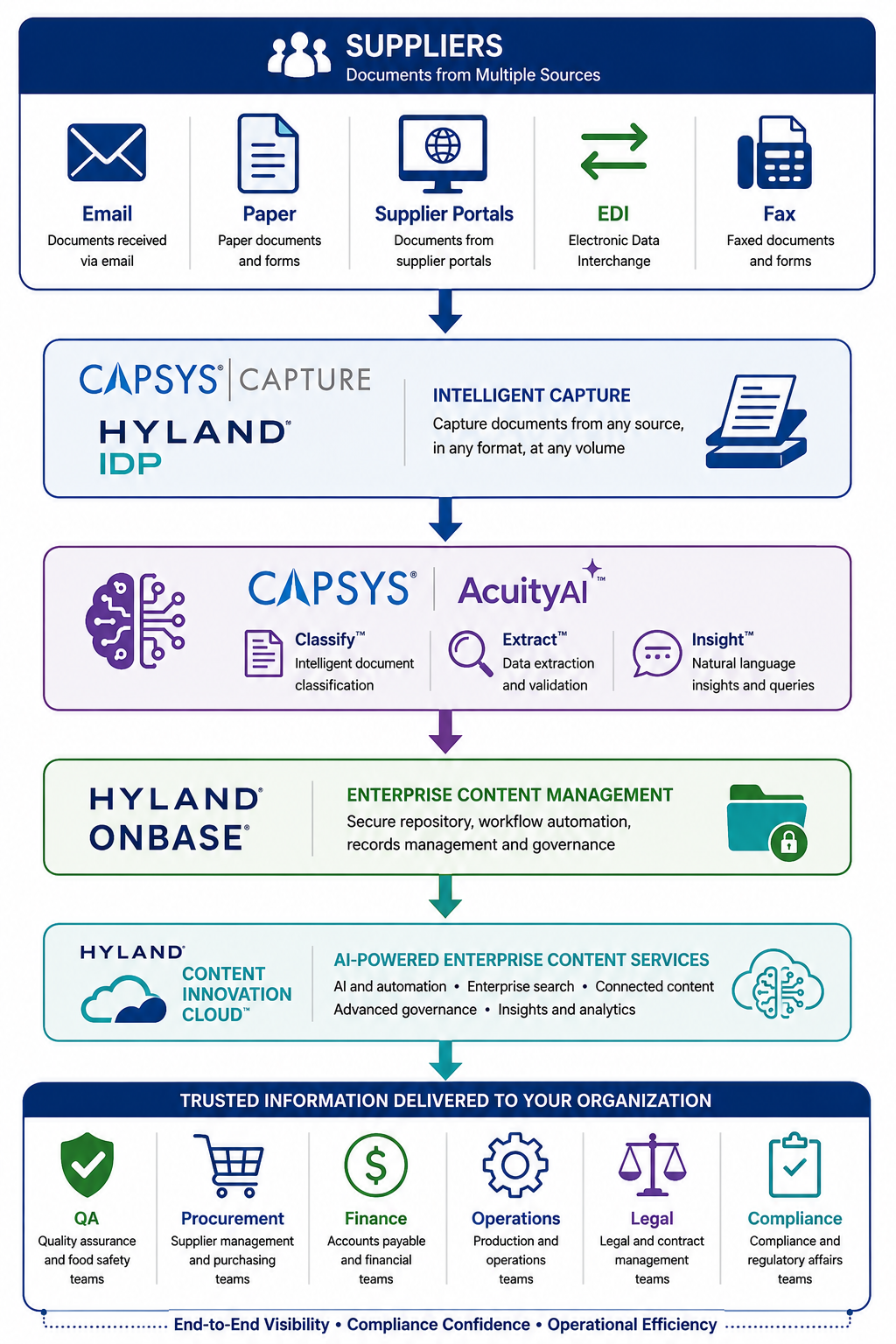
- Figure 1. An intelligent supplier information management workflow captures documents from multiple inbound channels, applies AI-powered classification and data extraction, securely manages content in Hyland OnBase, and delivers trusted information to the departments that rely on it most.
The Growing Volume of Supplier Documents
Every shipment arriving at a food manufacturing facility brings not only ingredients but also supporting documentation that validates quality, safety, and compliance.
Depending on the product and supplier, organizations may need to manage:
- Certificates of Analysis (COAs)
- Certificates of Conformance
- Ingredient specifications
- Allergen declarations
- Country of Origin documentation
- Organic, Kosher, or Halal certifications
- Food safety certifications such as Safe Quality Food (SQF), BRCGS, Food Safety System Certification (FSSC) 22000, and other Global Food Safety Initiative (GFSI)-recognized certification programs.
- FDA and USDA documentation
- Laboratory test results
- Bills of Lading
- Packing slips
- Purchase orders
- Invoices
- Supplier agreements
- Insurance certificates
Each document has value individually, but collectively they tell the story of every ingredient entering your supply chain.
When documentation is scattered across multiple systems, locating the right information becomes increasingly difficult—especially during audits, inspections, or product recalls.
Why Documentation Is Really About Risk Management
Supplier documentation is not simply administrative paperwork.
It is evidence.
Evidence that suppliers remain approved.
Evidence that ingredients met required specifications.
Evidence that food safety programs were followed.
Evidence that products complied with regulatory requirements.
When documentation cannot be quickly located or validated, organizations increase their exposure to operational disruptions, regulatory findings, and customer concerns.
The question is no longer whether documents exist—it is whether the right people can find the right information when they need it most.
Preparing for Audits Before They Happen
Whether preparing for an FDA inspection, a customer audit, or a GFSI certification review, food manufacturers often spend days gathering documentation from multiple departments.
- Quality Assurance searches shared drives.
- Procurement checks supplier folders.
- Operations reviews receiving records.
- Accounting retrieves invoices.
Valuable time is spent locating information rather than demonstrating compliance.
Modern enterprise content management solutions eliminate much of this effort by centralizing supplier documentation into a governed repository where authorized users can retrieve information within seconds.
With Hyland OnBase®, supplier documentation can be securely stored, indexed, and managed throughout its lifecycle with role-based security, version control, retention policies, and automated workflows.
Organizations no longer prepare for audits—they remain continuously audit ready.
Would Your Documentation Stand Up to an Audit Today?
If an FDA inspector or major customer requested critical supplier documentation this afternoon, how quickly could your team respond?
Our Food & Beverage Audit-Readiness Checklist helps you assess your organization’s ability to retrieve supplier certifications, Certificates of Analysis (COAs), traceability records, quality documentation, and other critical records when every minute counts.
Whether you’re preparing for your next audit or simply want to strengthen your document management processes, this complimentary checklist is a practical place to start.
- Download your free checklist today: Food & Beverage Audit-Readiness Checklist
Recall Readiness Depends on Information
Few situations place greater pressure on a food manufacturer than a product recall.
During a recall, every minute matters.
Organizations must quickly identify:
- Which supplier provided the ingredient.
- Which lots were affected.
- Which shipments were received.
- Which customers received finished products.
- Which Certificates of Analysis accompanied those shipments.
- What corrective actions were documented.
When information is distributed across disconnected systems, response times increase precisely when rapid action is most important.
By centralizing supplier documentation and related business information, organizations can significantly improve recall readiness while reducing operational disruption.
Managing Expiring Supplier Certifications
Many supplier documents have expiration dates that directly impact compliance.
Examples include:
- Food safety certifications
- Insurance certificates
- Organic certifications
- Supplier agreements
- Laboratory accreditations
- Quality certifications
Manually tracking these dates using spreadsheets or calendar reminders introduces unnecessary risk.
Workflow automation can notify appropriate personnel before documents expire, route replacement documentation for review, and maintain a complete audit trail of supplier compliance activities.
These capabilities help transform document management from a reactive process into a proactive compliance program.
Beyond Document Storage: Intelligent Supplier Information Management
Many organizations assume that storing documents electronically solves the problem.
In reality, simply converting paper into PDF files often moves the filing cabinet onto a network drive.
The real opportunity lies in transforming documents into usable business information.
Intelligent document processing automatically identifies incoming documents, extracts important business data, validates information, and initiates downstream business processes without requiring employees to manually review every page.
Instead of asking employees to organize documents, organizations allow technology to organize information.
Bringing AI into Supplier Documentation
Artificial intelligence is rapidly changing how food manufacturers manage supplier information.
Rather than manually sorting every incoming document, AI can identify document types, recognize suppliers, extract key business information, and make that information immediately searchable.
Solutions such as Hyland Intelligent Document Processing (Hyland IDP) and the CAPSYS AcuityAI™ suite significantly reduce manual indexing while improving consistency and accuracy.
For example:
- Hyland IDP can intelligently classify supplier documents, extract relevant business information, validate incoming data, and automatically initiate downstream workflows.
- CAPSYS AcuityAI Classify™ identifies document types such as Certificates of Analysis, Bills of Lading, laboratory reports, invoices, and supplier certifications without relying on rigid templates.
- CAPSYS AcuityAI Extract™ captures critical business information including supplier names, lot numbers, expiration dates, product identifiers, certificate numbers, and purchase order information.
- CAPSYS AcuityAI Insight™ enables users to ask business-oriented questions such as:
- Which suppliers have certifications expiring within the next 30 days?
- Show all Certificates of Analysis associated with Supplier ABC.
- Which ingredients were received from this supplier during the previous quarter?
- Which documents are missing before production can begin?
Together, these technologies reduce manual effort while improving visibility across supplier documentation.
Building an Intelligent Content Ecosystem
Managing supplier information requires more than a single application.
Successful organizations increasingly adopt an integrated content ecosystem that combines intelligent capture, enterprise content management, workflow automation, and AI-powered insights.
For many food manufacturers, that ecosystem includes complementary technologies such as:
- CAPSYS CAPTURE™, which captures supplier documents from scanners, email, fax, multifunction devices, supplier portals, cloud repositories, and other business systems.
- Hyland Intelligent Document Processing (Hyland IDP), which intelligently classifies documents, extracts business information, validates content, and automates business processes.
- Hyland OnBase®, which provides secure enterprise content management, workflow automation, records management, and long-term governance for supplier documentation.
- Hyland Content Innovation Cloud™, which extends these capabilities through enterprise-wide content services, AI-powered search, connected repositories, intelligent content orchestration, and advanced information governance across the organization.
- The CAPSYS AcuityAI™ suite, which complements these capabilities with advanced AI-driven document classification, extraction, natural language insights, and business intelligence designed to help organizations derive greater value from their supplier information.
Rather than replacing one another, these technologies work together to create a modern supplier information management platform that improves compliance, operational efficiency, and decision-making.
Turning Documentation into a Strategic Asset
Supplier documentation will continue to grow in both volume and complexity.
The question facing food manufacturers is no longer how to store documents, but how to transform them into actionable business intelligence.
Organizations that embrace intelligent supplier information management are better prepared for audits, respond more effectively to recalls, reduce manual processing, improve supplier visibility, and strengthen regulatory compliance.
At Integrated Document Technologies (IDT), we help food manufacturers modernize document-intensive processes by combining industry expertise with intelligent technologies, including Hyland Content Innovation Cloud™, Hyland OnBase®, Hyland Intelligent Document Processing (Hyland IDP), CAPSYS CAPTURE™, and the CAPSYS AcuityAI™ suite.
The result is a secure, intelligent content ecosystem that helps organizations capture information from virtually any source, automate document-centric processes, and transform supplier documentation into a strategic business advantage.
Ready to reduce audit scramble and manual document work?
Request a short Food & Beverage workflow review. IDT can help map how supplier, QA, logistics, and AP documents enter your organization today - and identify the fastest path to centralized control, expiration tracking, and automated routing.

About the Author:
Paul E. Szemplinski is the Founder and CEO of Integrated Document Technologies (IDT) and President and Co-Founder of CAPSYS Technologies. Since founding IDT in 1992, Paul has helped organizations across manufacturing, healthcare, financial services, government, insurance, and other regulated industries improve the way they capture, manage, secure, and automate business information.
With more than 30 years of experience in enterprise content management (ECM), document management, intelligent document processing (IDP), workflow automation, information governance, and digital transformation, Paul regularly shares insights on emerging technologies, AI governance, records management, business process optimization, and the future of information management.
His focus is helping organizations leverage technology responsibly to improve efficiency, compliance, security, and business outcomes.
Connect with Us:
