
Records Management and Information Governance
Records
Management with IDT and OnBase
Records Management automatically controls the retention of your organization’s associated business records securely and according to the retention policies your organization has established.
Typically, retention cycles of a folder are triggered by an event (or the passage of time), which ties records management strategies into organizational business processes. The module provides cutoff periods, retention plans and multiple destruction options. OnBase Records Management also offers exception handling as well as an administrative management interface.
Benefits of Records Management for your Business
- Enables complete life cycle management from document creation to declaration through its final disposition
- Improves consistency and precision by managing multiple documents as a single record
- Automatically declares documents as records using embedded, rules-based conditions
- Ensures timely disposal of qualified records automatically or after required approval
- Minimizes legal risks associated with accumulation of expired records
- Manages all electronic records within an IDT and an OnBase ECM solution
An Innovative Design
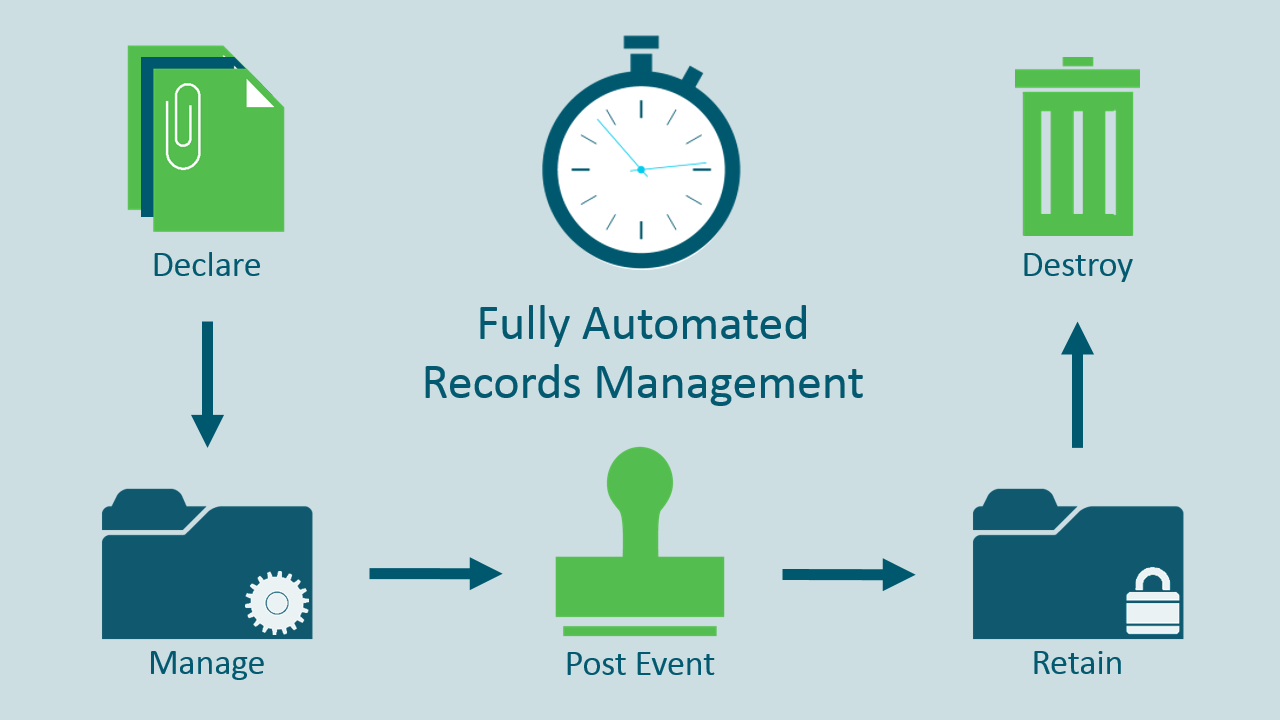
Documents, automatically declared as records (Declare), are auto-foldered into a managed folder that is in Open Status (Manage). An Event occurs (Post Event) on the record (folder) (e.g. employee separated, court case closed). When the event is posted, the record is moved to Closed Status, locking the record and preventing modification (Retain). This initiates the Retention Plan for the record. At the end of the retention period, the record, all documents and all metadata are destroyed (Destroy).
Use Cases for
Records Management
Services
GRaaS
What is Information Governance and Governance Rules as a Service?
Governance is about how an organization conducts itself. It encompasses an organization’s policies and actions and includes a framework of rules and practices by which a board of executives and/or its equivalent ensures accountability, transparency, and fairness. Information governance (IG) is about the consistent management of an organization’s informational assets, cohesive policies, guidance, processes, and decision rights for a given area of responsibility. IG includes a framework of rules and practices that may be directly linked to corporate governance.
GRaaS combines a fully researched, web-accessible retention schedule—powered by the Iron Mountain® Policy Center solution—with robust, rules-based automation to apply those same written retention rules directly to documents that reside in your content services platform solution from OnBase and IDT.
Why Should Organizations Assess Their Information Governance?

Most organizations are at risk of costly litigation due to noncompliance. Many organizations don’t realize how to go about properly assessing their risk level or how to begin this process. Organizations need to develop an information governance framework to begin solving these problems.
IDT’s Information Governance Assessment Overview
In almost every company, data is doubling each year, and managing all this new data can be a real challenge. IDT’s Information Governance Assessment is designed to help you discover areas of strength and opportunities for improvement. The results will empower you to increase organizational transparency and data integrity while reducing risk. The IDT Information Governance Assessment follows the ARMA International Generally Accepted Recordkeeping Principles® and Information Governance Maturity Model (IGMM). IDT’s assessment is software product agnostic and is not tied to any specific Information Management solution that a company already uses or is evaluating for ownership. As a standard, our assessment identifies the critical hallmarks of information governance and provides both a standard of conduct for governing information and metrics by which to judge that conduct. In doing so, your organization will be able to give assurance to the public and society at large that you are meeting your responsibilities with respect to the governance of information.
Download and read the fact sheet on Information Governance
Information Governance includes a Framework of Rules and Practices that may be Directly Linked to Corporate Governance
HOW IDT’S ASSESSMENT WORKS
During our content services assessment, we conduct a series of targeted interviews, posing strategically designed questions to your key stakeholders and executives. We are specifically looking to evaluate their understanding of the current policies, procedures, and use of tools to manage corporate information.
Assessment Deliverable
The outcome of our assessment is a report summarizing the data we collected, our findings, recommendations, and a score based upon the IGMM, which reveals the weaknesses and strengths of your information-handling practices. These initial assessment results provide a map for plotting risk mitigation strategies and a baseline for measuring program improvement. This process ensures accountability through subsequent periodic assessments to monitor progress toward the implementation of appropriate controls.
Testimonials
Latest Resources
IDT’s clients share our passion for results and it shows in their success. Learn more by reading our featured client results stories.
Here you will find a collection of information and resources in the form of videos, events, white papers, Q&A, and have the opportunity to read and watch what our clients are saying about their ROI-driven Content Services solutions provided by Integrated Document Technologies, Inc. (IDT).