

The Rise of AI Review Boards
Share this article:
Table of Contents
- AI Is Moving From Novelty to Infrastructure
- What Is an AI Review Board?
- Why These Boards Are Being Created
- The Core Purpose: Enable AI, But Do It Safely
- A Real-World Signal from Hyland: Control Tower
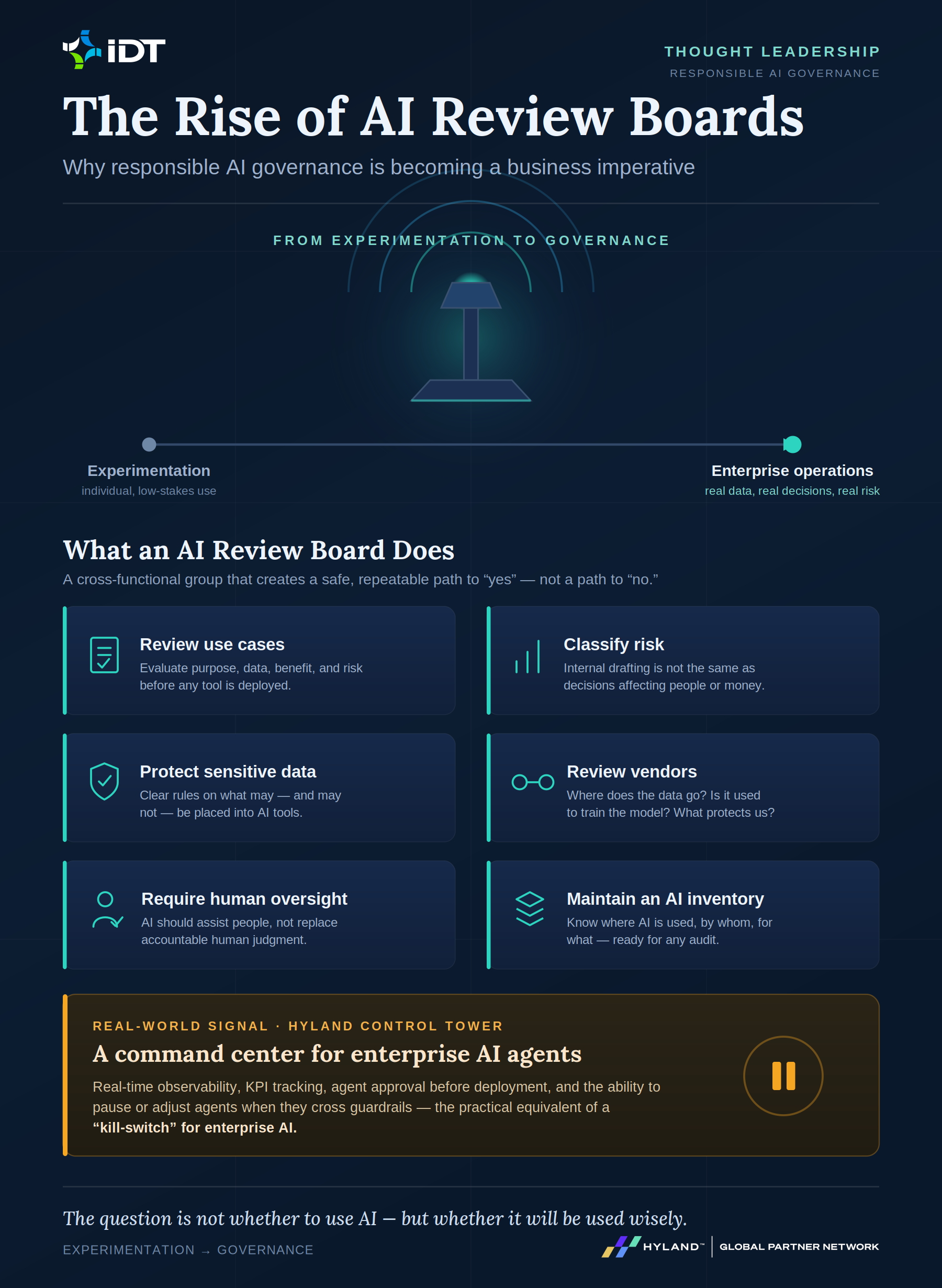
- What an AI Review Board Typically Does
- Why This Matters in Document-Intensive Businesses
- The IDT Perspective
- AI Governance Will Become a Competitive Advantage
- The Real Question Is Not Whether to Use AI
Why Responsible AI Governance Is Becoming a Business Imperative
Artificial Intelligence is no longer something organizations are simply “experimenting with.” It is showing up everywhere: document capture platforms, invoice processing systems, customer service applications, HR tools, legal review workflows, healthcare operations, financial processes, and everyday productivity software.
In many cases, AI is being introduced faster than the organization’s policies, procedures, legal review, cybersecurity controls, and executive oversight can keep up.
How do we take advantage of AI without creating legal, operational, cybersecurity, privacy, reputational, or customer-trust problems along the way?
AI Is Moving From Novelty to Infrastructure
For the past couple of years, many organizations have treated AI as a powerful new tool to explore. Employees have used it to summarize documents, draft emails, create reports, analyze data, write code, respond to customers, and improve productivity.
That experimentation has been valuable. But we are now entering a different phase.
AI is moving from individual experimentation into enterprise operations. It is becoming part of how work gets done. It is being connected to real business processes, real customer records, real documents, real decisions, and real downstream systems.
That changes the risk profile.
When an employee uses AI to help brainstorm a marketing idea, the risk is relatively low. When an organization uses AI to classify medical records, extract invoice data, summarize legal documents, evaluate employment information, process claims, or assist with customer-facing decisions, the stakes are much higher.
That is where governance becomes essential.
What Is an AI Review Board?
An AI Review Board is a cross-functional group responsible for reviewing, approving, monitoring, and documenting how AI is used within an organization.
Its job is not to stop AI. Its job is to make sure AI is used responsibly.
A well-run AI Review Board asks questions such as:
- Should this AI use case be allowed?
- What data will be used? Is the data confidential, regulated, or customer-sensitive?
- Who is accountable if the AI output is wrong?
- Is there a human review process?
- Is the vendor using our data to train its model?
- Can the process be audited?
- What happens when the AI makes a mistake?
- Does this use case create legal, privacy, security, or reputational risk?
These are not theoretical questions. They are the exact questions customers, auditors, attorneys, regulators, insurers, and boards of directors will increasingly ask.
Why These Boards Are Being Created
The reason AI Review Boards are gaining traction is simple: AI creates opportunity and risk at the same time.
That combination requires oversight.
Organizations want the productivity gains. They want faster document processing, better data extraction, smarter search, improved customer support, automated classification, and more efficient workflows.
But they also understand that AI can produce incorrect results, expose sensitive data, create bias, misclassify information, hallucinate facts, or introduce risk through third-party vendors.
In other words, AI is powerful enough to be valuable, but also powerful enough to require controls. That is the moment when governance becomes necessary.

The Core Purpose: Enable AI, But Do It Safely
The best AI Review Boards are not designed to say “no” to everything. They are designed to create a safe and repeatable path to “yes.”
They help the organization move from uncontrolled experimentation to managed adoption.
A good AI governance process allows a company to say: yes, we can use AI for this purpose; yes, this vendor is approved; yes, this data can be used; yes, this workflow has appropriate human oversight; yes, the output is being reviewed; yes, we have documented the risks; and yes, we can explain how this system is being used.
That kind of structure gives employees confidence, gives management visibility, and gives customers greater trust.
A Real-World Signal from Hyland: Control Tower
This trend is not just showing up in policy conversations. It is also showing up in the product roadmaps of major enterprise content management providers.
As a Hyland Partner, IDT pays close attention to how Hyland is approaching enterprise AI governance. At Hyland’s June 2026 CommunityLIVE event, Hyland publicly announced a new wave of AI platform innovations designed to move AI from experimentation to enterprise-wide adoption. That announcement included Control Tower capabilities as part of Hyland’s broader Enterprise Agent Mesh and Agent Lifecycle Management strategy.
In practical terms, Hyland described Control Tower as an operational command center for AI agents. It is intended to provide real-time observability, business metrics, agent approval before deployment, KPI tracking, and the ability to take corrective action in real time, including pausing or adjusting agents based on metric thresholds, guardrail violations, or business impact.
That last point is especially important. For many executives, the phrase “AI governance” can sound abstract. But the ability to pause, adjust, or stop AI agents when they violate guardrails or begin creating unacceptable business risk is very concrete. It is the practical equivalent of a kill-switch control for enterprise AI.
This reinforces the larger point: responsible AI adoption is not only about writing policies. It is about building operational controls into the systems that use AI. The best AI governance programs will combine executive oversight, legal and compliance review, cybersecurity discipline, vendor governance, human review, auditability, and technical controls that can intervene when AI behavior moves outside acceptable boundaries.
Source: Hyland Newsroom, June 1, 2026; Hyland IDT Partner Profile
What an AI Review Board Typically Does
An AI Review Board usually performs several important functions.
First, it reviews proposed AI use cases. Before a department deploys an AI tool, the board evaluates the business purpose, data involved, expected benefit, and potential risk.
Second, it classifies risk. Not every AI use case is equal. Drafting internal content is very different from using AI to make recommendations that affect employees, customers, patients, citizens, or financial outcomes.
Third, it protects sensitive data. One of the most immediate concerns with AI is data leakage. Organizations need clear rules about what information employees can and cannot place into AI tools. IDT's Records Management and Information Governance practice is built around exactly this kind of disciplined data control.
Fourth, it reviews vendors. Many software products now include AI features. Before those features are enabled, someone needs to understand where the data goes, how it is stored, whether it is used for model training, and what contractual protections exist.
Fifth, it requires human oversight where appropriate. In many business processes, AI should assist people, not replace accountable human judgment.
Sixth, it helps maintain an inventory of AI systems. Organizations need to know where AI is being used, by whom, for what purpose, and under what controls.
That inventory may become increasingly important for audits, cybersecurity reviews, customer due diligence, insurance applications, legal discovery, and regulatory inquiries.
Why This Matters in Document-Intensive Businesses
This subject is especially relevant for organizations that manage large volumes of documents, forms, records, faxes, invoices, claims, correspondence, and case files.
These are the environments where AI-driven document processing can deliver significant value.
AI can help classify documents. It can extract key data from forms and invoices. It can assist with routing records to the right department. It can summarize large document sets. It can identify missing information. It can improve search and retrieval. It can reduce manual data entry. It can accelerate downstream workflow.
But these same environments also carry real risk.
A misclassified document can be routed incorrectly. An extracted invoice amount can be wrong. A customer record can be exposed to the wrong system. A medical, financial, legal, or government record can be mishandled. A hallucinated summary can create confusion or downstream error.
This is why AI governance is not just a concern for large technology companies. It is directly relevant to any organization that depends on accurate, secure, and defensible information management.
The IDT Perspective
At Integrated Document Technologies,Inc. (IDT), we have spent decades helping organizations capture, manage, process, and protect business-critical information. We understand that technology is only valuable when it fits into the realities of the organization.
That means security matters. Accuracy matters. Workflow matters. Auditability matters. Compliance matters. Accountability matters.
And now, AI governance matters.
As AI becomes more deeply embedded into document capture, enterprise content management, intelligent data extraction, and business process automation, organizations will need to ask better questions before deploying AI-enabled solutions.
Questions such as: What problem is this AI system solving? What data does it need? Where does that data go? Who can access it? How accurate is the output? How are exceptions handled? Is there a human review process? Is there an audit trail? Can the system be monitored over time? Can we explain this process to a customer, auditor, regulator, or executive team?
These are the kinds of questions an AI Review Board is built to address.
AI Governance Will Become a Competitive Advantage
Some organizations will view AI governance as a burden. We believe that is the wrong way to look at it.
Done properly, AI governance becomes a competitive advantage.
It allows an organization to innovate faster because the rules are clear. It gives customers confidence that AI is being used responsibly. It reduces internal confusion. It helps avoid careless use of sensitive data. It creates a framework for evaluating vendors. It gives executives better visibility into where AI is being used across the enterprise.
Most importantly, it builds trust.
And trust will become one of the defining issues in the AI marketplace.
Customers will not only ask whether a vendor has AI. They will ask how that AI is governed.
They will want to know whether their data is protected. They will want to know whether outputs are reviewed. They will want to know whether the system can be audited. They will want to know whether there is accountability when the AI gets something wrong.
Organizations that can answer those questions clearly will be in a stronger position than those that cannot.
The Real Question Is Not Whether to Use AI
AI is here. The question is not whether organizations will use it. They already are. The better question is: Will AI be used in a disciplined, secure, transparent, and accountable way?
That is the purpose of an AI Review Board.
It gives organizations a practical structure for responsible adoption. It helps balance innovation with risk management. It creates a process for approving use cases, reviewing vendors, protecting sensitive data, requiring human oversight, and documenting decisions.
That is not red tape. That is good business.
Final Thought
The rise of AI Review Boards is a sign that AI has entered a more mature phase.
The early stage was experimentation. The next stage is governance.
For organizations that manage important documents, sensitive data, regulated records, and mission-critical workflows, this evolution is not optional. It is essential.
AI has the potential to dramatically improve how information is captured, classified, extracted, routed, and used. But that potential must be matched with responsibility.
At IDT, we believe the future belongs not simply to organizations that adopt AI quickly, but to organizations that adopt AI wisely. Learn more about how IDT helps organizations manage information responsibly.

About the Author:
Paul E. Szemplinski is the Founder and CEO of Integrated Document Technologies (IDT) and President and Co-Founder of CAPSYS Technologies. Since founding IDT in 1992, Paul has helped organizations across manufacturing, healthcare, financial services, government, insurance, and other regulated industries improve the way they capture, manage, secure, and automate business information.
With more than 30 years of experience in enterprise content management (ECM), document management, intelligent document processing (IDP), workflow automation, information governance, and digital transformation, Paul regularly shares insights on emerging technologies, AI governance, records management, business process optimization, and the future of information management.
His focus is helping organizations leverage technology responsibly to improve efficiency, compliance, security, and business outcomes.
Connect with Us:
